
UX Research & Usability Testing for Better Digital Products
Understand how real users experience your product before relying on assumptions. Klyssel Labs combines user research, usability testing, journey analysis, heuristic evaluation, behavioral insights, and product analysis to identify friction and help teams make more informed design and product decisions.
Replacing Product Assumptions with Empirical User Evidence
Why internal team intuition blindsides product roadmaps, and how our structured user testing reveals true behavioral friction points before costly engineering rework.
The Blind Spots of Feature-Centric Development
Users may struggle to understand navigation, complete important tasks, find information, recover from errors, or understand what they should do next. Teams working closely with a product can also become accustomed to problems that new users immediately encounter.
Without direct user evidence, product teams may spend time improving features that are not the most important sources of friction.
Qualitative Depth Combined with Quantitative Rigor
We combine qualitative and quantitative methods where appropriate, including user interviews, usability testing, journey analysis, heuristic evaluation, analytics review, task analysis, and competitive research.
The goal is to identify meaningful user problems, understand why they occur, prioritize opportunities, and translate research findings into practical recommendations that designers, product teams, and developers can act on.
Core Capabilities & Deliverables
Systematic user research covering user interviews, moderated testing, heuristic audits, customer journey mapping, and prioritized UX roadmaps.
User Interviews
Conduct structured conversations with relevant users or stakeholders to understand needs, expectations, workflows, frustrations, motivations, and product experiences.
Usability Testing
Observe users completing representative tasks to identify navigation problems, confusing interfaces, interaction friction, unclear content, and other usability issues.
Heuristic Evaluation
Review interfaces against established usability principles to identify potential problems with navigation, feedback, consistency, error handling, accessibility, and interaction design.
User Journey Analysis
Map important customer or user journeys to identify friction points, gaps, unnecessary steps, and opportunities to improve the overall experience.
Product & UX Audits
Evaluate existing digital products across usability, information architecture, interface patterns, content, workflows, responsive behavior, and other relevant UX dimensions.
Research Insights & Recommendations
Translate research findings into prioritized UX recommendations, supporting evidence, opportunity areas, and actionable next steps for product teams.
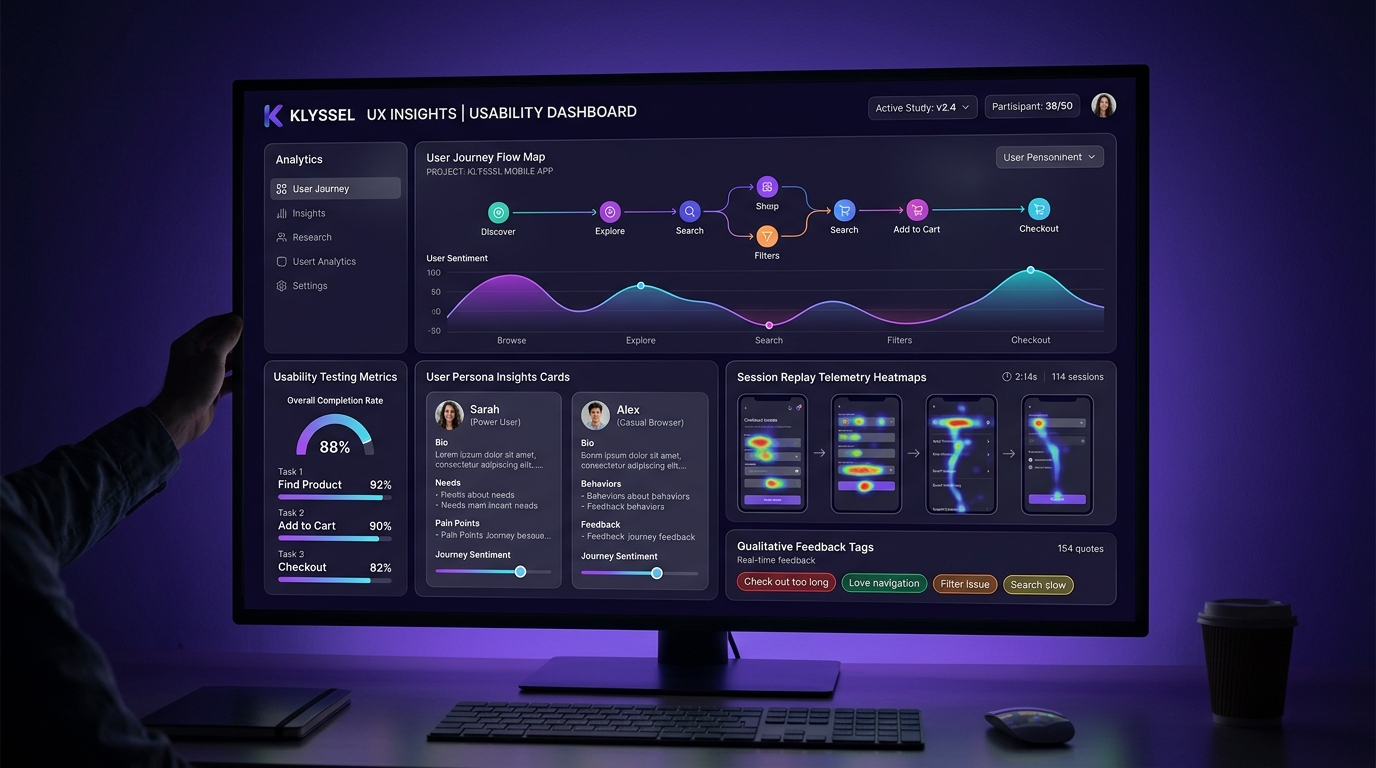
UX Telemetry & Usability Insights Dashboard
An inside view into Klyssel's research synthesis platform: mapping user journey sentiment curves, persona motivations, task completion rates, and session heatmaps to eliminate product friction.
Measurable Operational Outcomes
UX research does not guarantee specific business outcomes. Its value comes from reducing uncertainty and helping teams make better-informed product decisions:
Direct User Evidence
Replace assumptions with direct behavioral evidence about user needs, workflows, and friction.
Reduced Friction
Eliminate confusing user flows, redundant steps, and navigation bottlenecks across the product.
Confident Prioritization
Help engineering teams focus on the high-impact problems that directly drive retention and satisfaction.
Lower Rework Cost
Validate concepts and prototypes before engineering buildout to prevent costly post-launch rewrites.
Product improvements and user engagement outcomes depend on team implementation speed, audience size, product maturity, and broader market conditions.
Architecture & Technology Stack
Klyssel Labs selects research methods and tools based on the product, target users, research questions, and project scope.
Research Methods
- Moderated & unmoderated user testing
- 1-on-1 contextual user interviews
- Task completion & time-on-task analysis
- Nielsen Norman heuristic evaluations
- Card sorting & tree testing studies
Behavioral & Analytics
- Google Analytics 4 & product telemetry
- Mixpanel & PostHog event funnels
- Session recording & rage click analysis
- Form field drop-off diagnostics
- System Usability Scale (SUS) scoring
UX & Prototyping Tools
- Figma clickable interactive prototypes
- Miro & FigJam user journey mapping
- Information architecture diagrams
- Low-fidelity wireframe concept testing
- Qualitative research transcript repositories
Research Deliverables
- Prioritized UX recommendation matrices
- Video highlight reels with timestamps
- Empirical user persona archetypes
- End-to-end customer journey maps
- Executive summary slide decks
Klyssel Labs selects research methods and tools based on the product, target users, research questions, and project scope.
Implementation Lifecycle
A disciplined engineering flightpath designed to validate business value before production scale.
Research Planning & Discovery
We define the research objectives, target users, key questions, product context, existing evidence, business goals, and decisions the research needs to support.
Research & User Observation
Depending on the project, we conduct interviews, usability tests, product analysis, heuristic evaluations, journey reviews, analytics analysis, or other appropriate research activities.
Findings & Problem Identification
Research evidence is organized into recurring patterns, usability issues, user needs, friction points, and opportunities. Findings are supported by relevant observations and evidence.
Prioritization & Product Recommendations
We translate findings into practical recommendations and prioritize issues based on factors such as user impact, business relevance, frequency, severity, and implementation considerations.
Frequently Asked Questions
Key answers to common questions about architecture, system integration, security, and project delivery.
Understand Your Users Before Building the Next Feature
The most useful product improvements often begin with understanding where users struggle. Klyssel Labs combines UX research, usability testing, behavioral analysis, journey mapping, and product evaluation to turn user evidence into practical design and product decisions.
Tell us what you're building, who uses it, and what you currently believe the biggest user problems are. We'll help define the research questions, methods, and usability evaluation approach.
